by Adrian Warren (director)
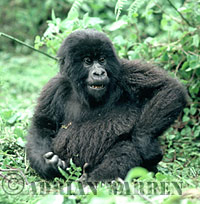
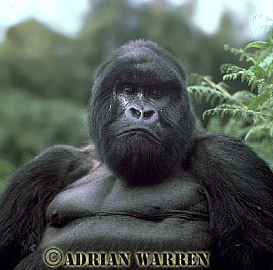 Mountain Gorilla (Gorilla g. beringei), Virunga Volcanoes, Rwanda Mountain Gorilla (Gorilla g. beringei), Virunga Volcanoes, Rwanda |
The gorillas cooperated but the guerillas did not. When war erupted in the tiny central African country of Rwanda in September 1990, it added a new dimension of difficulty to the already arduous task we had set ourselves of filming mountain gorillas with IMAX equipment. The aim was to try, for the first time, to make a film on the natural behaviour of wild animals for the giant screen format of IMAX/OMNIMAX. For the uninitiated, the IMAX screen is approximately seven stories tall and is "flat"; the OMNIMAX screen is even larger and is dome-shaped: both fill the peripheral vision of the audience in the theatre and that, linked with a very sophisticated three dimensional sound system offers a sensation that is close to reality.
|
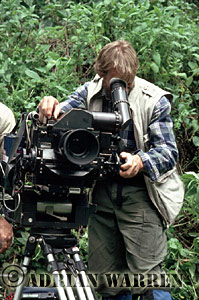
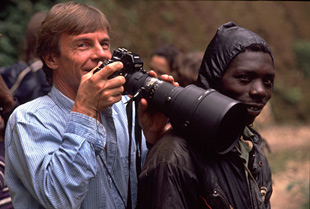
Neil Rettig with IMAX Camera |
We knew it would not be easy. We had just finished another film on Mountain Gorillas the year before, a co-production for the BBC Natural History Unit and WNET New York, on the 16mm format, so we knew what we had in store for us. Steep mountainsides, altitude, cold, rain, mud, stinging nettles, and up to four hours climbing each day before we would even be in a position to start filming the gorillas - that is, if they decided to be cooperative.
Now add to that the burden of heavy equipment - the IMAX camera alone weighs fifty kilos; the battery another fifteen; the tripod a further thirty or so; an expensive 300 metre roll of film lasts a mere three minutes with a slow, laborious process to re-load; the lenses are wide angle which means you have to be close to your subject; focus and exposure are critical - especially with gorillas that are essentially black and soak up the light; and, as if all that is not enough, the camera is noisy. There were those who told us we were mad, one prospective crew member asked us if we were going to build a pen to keep the gorillas in one place - when we told them it would be impossible to "control" the gorillas and that if we tried to pressure them we would be asking for trouble, they just shook their heads in disbelief. It would be a question of patiently and persistently following the gorillas across the mountain hoping for an opportunity to record interesting behaviour, but not necessarily the first thing that happens; whatever we filmed had to fit a storyline within the tight constraints of a fixed budget. Natural history film-making teaches you about patience and persistence and I decided, for obvious reasons, to invite essentially the same dedicated group of people that worked with me on the previous gorilla film to join me for this one.
|
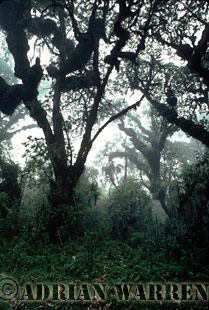
HAGENIA FOREST, Mountain Gorilla Habitat |
So in addition to the all-important support group from IMAX Corporation in Toronto, our team comprised Cameraman Neil Rettig and his Camera Assistant Kim Hayes, Sound Recordist Christopher West and Zoologist Craig Sholley - all the best in their field. Craig's experience goes back over many years of Mountain Gorilla research and culminated in his Directorship of the Mountain Gorilla Project in Rwanda which existed to advise and assist the Government in the management of Parc des Volcans, the organisation of anti-poaching patrols, and conservation education. Craig knew the gorillas individually so his knowledge was extremely valuable to our understanding of the gorillas' social behaviour and relationships. We were joined, later, by George and Kay Schaller, whose unsurpassed reputation and experience as field biologists is of international eminence, and who made, in 1959-60, the first definitive study of Mountain Gorillas.
|
George Schaller, the first definitive study of Mountain Gorillas |
The plan was to make four filming trips, each lasting 6-7 weeks, over a period of a year to give a good cross section of seasons and gorilla behaviour. Working in the Virunga volcanoes which, although arduous, must be one of the most beautiful areas in the world, and with such peaceful animals as the gorillas, the last thing we expected was an invasion by rebels from Uganda. Sitting hour after hour with the gorillas, the rest of the world with all its selfish problems seemed so far away. The first time we were evacuated, in September 1990, we were well ahead of the problems; the second time, in late January 1991, it was a little too close for comfort - we were woken at dawn by automatic gunfire around our house in Ruhengeri and were forced to spend seven hours huddled on the floor while mortars and grenades exploded outside and bullets ricocheted off our walls and roof. Three members of our party, in another building, were kidnapped by rebels and had to run across an open field under machine gun fire. When we were forced to leave that second time, we knew it would be the last.
 |
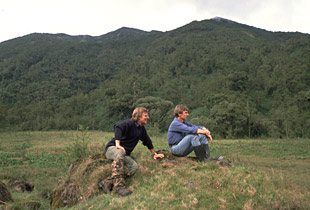 |
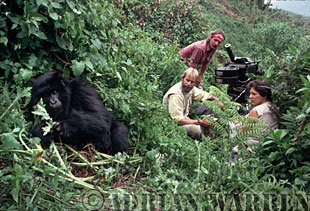
IMAX Team on Location
(Neil Rettig, Kim Hayes and Craig Sholley) |
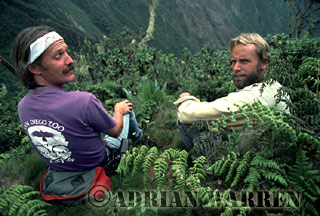
IMAX Team on Location
(Christopher West and Adrian Warren) |
 |
 |
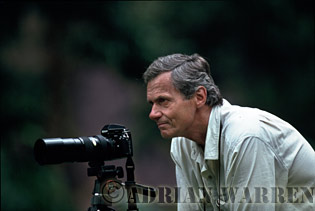
Adrian Warren |
Team on location (Craig Sholley and Neil Rettig) |
The day we had set off to Rwanda to begin the IMAX filming project had been an important one for me. IMAX projects are demanding but the rewards are great. I wanted our film to be the first of a library of wide screen films about endangered species and the environment, not only to promote an awareness in our natural heritage but to document it before it is too late.
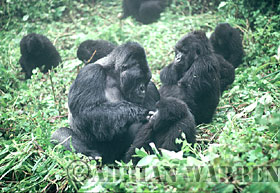
Today there are only a few hundred Mountain Gorillas left. Under normal circumstances their situation has been fragile, but in the last two years, due to the war in Rwanda, the instability and hostilities made their situation critical. When we began our IMAX film we had chosen to work with group 13, whose silverback leader "Mrithi" was to be tragically killed by military gunfire, and the Susa group, the largest known group of Mountain Gorillas at that time under the leadership of Imbaraga, another extremely tolerant and charismatic silverback with whom we had worked previously on our BBC film "Gorillas in the Midst of Man". His group of over thirty gorillas included many juveniles which we hoped would give us good possibilities for filming play behaviour.
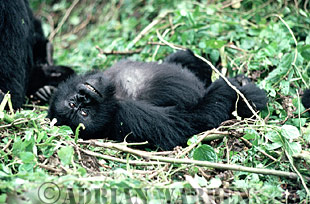
Imagine our shock and distress when, on arriving to begin the first six weeks filming for IMAX, we found Imbaraga with a serious chest infection, and within four days this all-powerful male was dead. Such is the personality of these gorillas that his body, when brought down from the mountain seemed only half the size that he had been in life. Following Imbaraga's death, a subdominant male silverback, Umogome, took over leadership. But he was (as he looks in his photograph) not the calm leader that Imbaraga was, he was always a little edgy when we were present and his leadership quickly became challenged by a younger male -a drama thatunfolds itself in the IMAX film.
|
 |
The The death of Imbaraga was possibly due to disease transmission from a human visitor, and underlined the importance of keeping our distance from the gorillas - where possible a minimum of five metres, and we were always very strict about our own health when visiting the gorillas. Inevitably, keeping a respectable distance was not always possible - working with them day after day, their initial curiosity gave way to a trusting relationship and the juveniles, in particular, accepted us as part of their environment. But whenever we approached the group, we always walked quietly, softly, often crawling through the vegetation on our hands and knees making our own interpretation of gorilla calming sounds when we were very close.
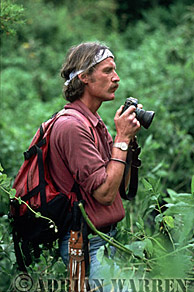
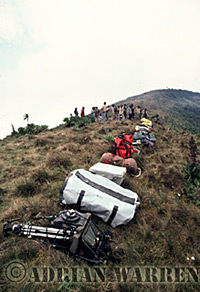
As we approached the gorillas, Craig would go on ahead to assess their mood and situation. Meanwhile, Neil, Kim, Chris and I would start to assemble the equipment. Then, under the watchful gaze of our gorilla friends we would slowly move the equipment in piece by piece - first the tripod, then the tripod head, battery, cables, lenses, and finally the monster camera itself which took two people to carry. Every move we made had to be calm and gentle, so the process was a slow one. Often by the time we were ready the gorillas decided it was time to move on; and so, after hours of climbing up the mountain with the equipment, and finding the gorillas we would have to disassemble it again and follow them. This process could repeat itself for days on end with no film passing through the camera. But then suddenly it would all happen and we would come down the mountain at the end of the day exhausted but triumphant. Wielding the IMAX camera around the Virunga Volcanoes was a daunting task. Normally when you go on the road with an IMAX crew and sixty or so cases of equipment you work out of a 10 ton truck and a couple of 4-wheel drives thrown in. In the Virungas we were on foot, and even with the equipment reduced to a minimum we employed at least sixteen porters on a daily basis to help us. The camera had to be supported on a tripod for filming - there was no way it could be hand held like a 16mm camera can. So once it is in place it is not very versatile or manoeuvrable.
 |
 |
Craig Sholley |
Team on location |
Sometimes we would have the camera ready for one shot and a gorilla would sneak up behind us and catch us unawares. We also had to keep a careful eye on any objects we placed on the ground - the gorillas are intelligent, observant and curious, and more than once we almost lost a lens or a plastic bag when a young gorilla made a cunning approach and took us by surprise.
After many weeks of work with the same gorillas, they seemed to accept our presence very readily. I often wondered how we seemed to them - did they wonder where we disappeared to at night? After working with the tripod for many weeks we tried using a rail device to give the camera some movement on group shots. The gorillas were very curious about this new piece of equipment and we had to be careful about its use. It meant having an immense amount of hardware close to the gorillas, and such were the complications in setting it up that one shot was all we could expect to achieve in a day, if we were lucky. For that reason we worked hard on filming behaviour, pure and simple, from the beginning, a decision which I was very happy to have made when hostilities brought our work to an untimely end.
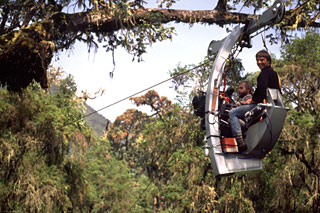
We had been working up in the forest near Karisoke with George and Kay Schaller and had just finished a complicated sequence involving a cable rig which we had designed and built to move the camera aerially between the trees.
|
Adrian Warren and Neil Rettig on IMAX Cable car rig in forest |
We knew there was fighting further to the east with groups of rebels carrying out hit and run raids across the border from Uganda, since we would occasionally hear distant busts of gunfire, but we hoped that our area, being remote, would remain unaffected. But when a group of rebels headed in our direction, the Rwandese military ordered us off the mountain (for our own safety) and the following morning we found ourselves in a battle which lasted all day, while we lay on the floor of our little house in Ruhengeri helplessly listening to the fighting outside. That was the end of the filming - we were evacuated, never to return. I was worried because there were still sequences that I had wanted to film - more with George Schaller, and some aerials of the forest and volcanoes. But when we took the film into the editing room, we found we just couldn't get enough of the gorilla behaviour - their appeal was so strong that sequences involving human beings seemed obtrusive. So we didn't seem to need the sequences that the war prevented us from achieving. The gorillas speak for themselves - their individual personalities, their intelligence, and curiosity come across on the big screen, as does the fragility of their future.