 |
Jimmy Angel and his wife Marie |
It was a big operation, and many said it was a foolhardy one; like the summit of Roraima, the top of Devil Mountain is rocky, and divided by deep canyons. Jimmie persuaded two friends, Gustavo Heny and Felix Cardona, to make an expedition in advance, on foot, to examine a break in Auyantepui's cliffs to see if it might serve as an escape route from the rocky plateau, just in case anything should happen to the plane. Heny and Cardona were successful, and made the first ascent of Auyantepui in 1937.
Weeks later, Jimmie Angel, accompanied by his wife Marie, Heny, and Miguel Delgado, set up camp on a high area of savannah close to the cliffs and the escape route. Cardona was also there, but would remain in camp as a radio contact. It was from here that they took off to attempt a landing on the summit to look for gold. Jimmie made searched several areas on the 150 square mile summit to look for a possible landing area, and finally found what he was looking for: a more or less level grassy area not far from his famous waterfall. Angel and his companions prepared for a landing.
|
Jimmy's crashed landing on Auyantepui |
After circling to prepare carefully for his approach, he cut the engine to reduce the risk of damaging the propeller. The final approach was good and on touching down the wheels rolled on the grassy surface, but, as the aircraft slowed, the wheels sank into some soft mud and the plane turned on its nose. Luckily, no one was hurt.
Angel's party spent two days trying to salvage the plane, but it was clear that they would have to make their escape on foot. Their dreams of finding gold were redirected towards their own survival. Since attempts at radio communication to Cardona had failed, they left a simple message in large letters on one of the wings, pointing in the intended direction of their walk. It must have been a daunting prospect to traverse the unexplored surface of Auyantepui since the summit plateau is so huge; its labyrinth of rocks and ravines forcing an arduous zigzag route over even the shortest distance. It took eleven gruelling days for Jimmie and his companions to escape from Auyantepui.
ot all have been so fortunate. Like Roraima, Auyantepui does not make life easy for visitors intent on exploring its misty summit or its canyons. Many have died or suffered serious injury in the attempt. The local Indians will tell you about the mischievous spirits that lurk on the Tepuis, waiting to hurl misfortune on those who trespass on the summits, and it's a common observation by those who climb these mountains: one feels strangely oppressed, like an intruder in a hostile place.
 |
DC3 Wreck, near Auyantepuis |
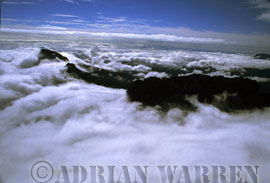 |
A tepuis in clouds |
The Tepuis are also treacherous for those fly aeroplanes. The abrupt cliffs are often shrouded by cloud, and maps are not detailed enough to protect an unwary pilot from flying straight into hidden cliffs; and around their sheer walls, turbulence, winds, and powerful down draughts can pull an aircraft into places from which it is not possible to escape. It is also easy to become lost when flying over the endless forest; engine failures have claimed many lives. With no clearings in which to attempt an emergency landing, an aeroplane plunges through the forest canopy, the leaves and branches springing back to swallow up the evidence. The chances of escape are slim and the chances of being found and rescued negligible. Tepui country is littered with old aeroplane wrecks.
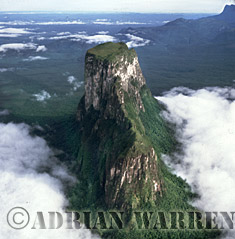 |
Cerro Autana |
If it wasn't for aviators though, most of this country would still be completely unknown. In the sixties, a pilot was flying around a small Tepui called Autana, far to the west. Autana is spectacular: it is actually higher than it is wide and its tiny summit sits isolated atop sheer cliff walls rising almost vertically for 4,000 feet from near sea level forest.
The unique feature of Autana though is a cave system, some 800 feet below the summit, the huge tunnels passing through the mountain from one side to the other. These ancient tunnels are claimed to be the oldest caves in the world, and represent an underground river system of old time, now seen in cross section. It is difficult to say when water last flowed through these tunnels, but they were formed some 300 million years ago, before life appeared on this planet, at a time when the summit of this tiny Tepui, along with the summits of the other Tepuis were joined, and represented the old level of the land.