 |
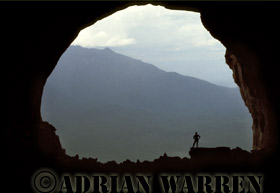
Cave, Cerro Autana |
In 1985, we carried out an expedition to Autana-tepui, arriving on the summit by skydiving out of an old DC3. While we were there, we abseiled for almost 800 feet down the wall of Autana to reach the caves. The scale of the place was unbelievable - the ledge outside the cave had seemed tiny from the plane but was actually covered by trees and enormous boulders. And the cave itself was vast, with a central chamber in the heart of the mountain reminiscent of a cathedral dome. We found ancient water marks on the walls of tunnels, and beds of pebbles, polished in ancient times by the action of water.
To fly from Autana to Roraima takes several hours in a small plane, but, a very long time ago, their summits were connected as a huge sandstone massif. The forces and upheavals of Continental Drift however started a fragmentation process, breaking up the massif into the hundred or so individual Tepuis as we know them today. The natural ageing erosion processes of rain and wind have done the rest, including the surreal sculpturing of the rock labyrinths on the summits of Roraima.
|
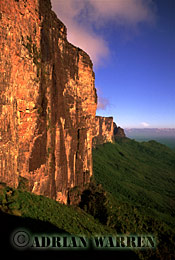
Cliff of Rorainma from the ledge |
Like so many adventurous tourists do today, I followed Im Thurn's and Perkins' ascent route up to the summit plateau by way of the famous ledge. When I first climbed it in 1974, visitors were infrequent. Now, parties of people make the easy climb almost every day. The trail is now a highway of earth pounded hard by the passage of many people.
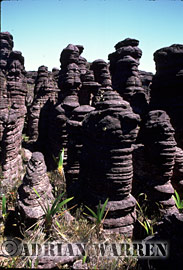 |
Rock shapes, Roraima summit |
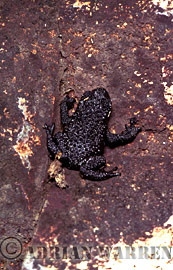
Reaching the summit, though, is still a magical experience; the towering caricatures of rock faces create an eerie landscape that cannot have changed very much in millions of years. In every direction there is sculptured rock, eroded into grotesque and tortured shapes by the action of rain and wind. The surroundings are so lacking in familiar objects or frames of reference that it is difficult to judge distances accurately and to maintain one's sense of direction. There is also an extraordinary and haunting silence; although one strains the ears to hear something through the gentle whistling of the wind, there is little sound here save for an occasional bird, and the gentle 'pipping' of an unique little black frog known from nowhere else in the world. When you spend a long time in a place like this, your imagination begins to play tricks on the mind.
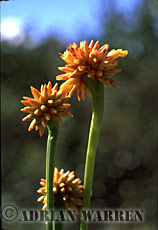
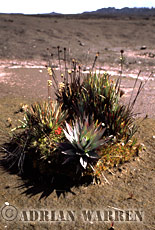
The first thing one notices is that Roraima, like other Tepuis, is a botanical paradise; almost every plant you see on Roraima is only known from this one bleak mountain top. Among the rocky labyrinths, areas of flat rock and boggy depressions, there is little to cling to, except shallow soil or tiny rock crevices. It's a harsh environment where temperatures can soar and then drop to freezing, and where sudden storms bring fierce winds and flash floods. Yet there are many fragile and beautiful species of plant that seem to thrive, some of them bearing flamboyant, colourful flowers.
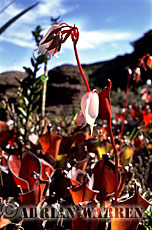
The plants of Roraima are specialists in the art of survival. In order to cope with nutrient poor soils, carnivorous plants like sundews, bladderworts, pitcher plants, and even a bromeliad species all supplement their diet by trapping and digesting insects.
|
|
|
|
|
|
Heliamphora nutans |
Oreophrynella quelchii |
Other species have developed thick waxy leaves to help retain water when temperatures soar. Orchids, so successful in colonizing such environments, are plentiful here, with flowers ranging from large and showy, down to the size of a pin head.
Crossing the summit of Roraima is not an easy task. Between me and the northern prow were several miles of cliffs, loose rock, and deep canyons, but I wanted to satisfy a twenty nine year old challenge. Walking across the ancient sandstone, one can see the process of erosion that formed this place in action. In places, layers of sedimentary sandstone have worn away, exposing fossil ripple marks, suggesting that the summit of Roraima was perhaps, back in Precambrian times, the bed of a shallow lake. Everywhere, rain water collects in deep pools, its course channelled along furrows, the embryos of deeper crevices, cracks and canyons that form a complex network of barriers hampering progress on foot in any direction. Some of the sedimentary layers of sandstone are softer than others, and it is these that have eroded more quickly, producing amazing rock shapes, and exposing layers of quartz crystals.
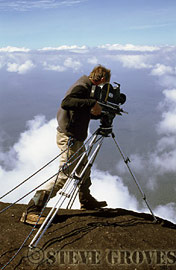 |
Adrian Warren filming from the Prow of Roraima |
My route led me due north through the labyrinths of rocks; following the course of streams of water stained golden by plant tannins; across bleak, windswept areas of flat rock where the delicate pink colour of the sandstone has been blackened by a coating of surface algae and fungi; across wide gullies filled with other worldly plants; until, finally, only a few rocky crevices separated me from my goal. Finally, just a few more steps would take me to the very tip of Roraima's prow. It commands an extraordinary view, looking north across hundreds of miles of unbroken forest in Guyana. Looking vertically down I could see the ridge we had climbed thirty years before. It reminded me of the thrill of my first experience in a place where no human had been before. It also reminded me of some of the scientific discoveries of that first expedition.
Strangely enough, the most exciting find for me was not one of the new species; but a small frog that was only previously known from a single specimen discovered by the first scientists who came to the south side of Roraima in 1898. It had not been seen for seventy three years until I stumbled across one close to the north ridge. Having found one, I searched for and finally collected three more. The frogs that I had found are closely related to the small black frog found on Roraima's summit. It's called Oreophrynella; it is even more ancient than the dinosaurs, and, curiously, it is more closely related to African species than any in South America. These frogs may have been here for many millions of years, since the time when the Tepuis were joined together as one massif. As a frog, it has certain primitive characteristics: it can neither hop nor swim, but it does have special adaptations that help it to survive on Roraima. It has opposable toes which help it cling to slippery rock surfaces; when it's cool, its black colour helps it to keep warm; and when it's hot, it finds shade or immerses its body in running water.
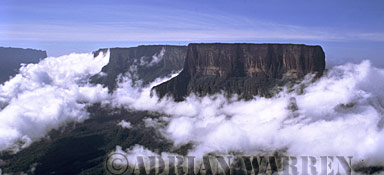 |
Kukenaam from the North |
The interesting question for me was, if populations of this black frog managed to survive as the ancient sandstone massif broke up into isolated blocks, it should not be limited to Roraima. On subsequent expeditions, therefore, I made a point of searching for this frog on other tepuis, and, in 1974, I discovered it living on the summit of Auyantepui, far to the west of Roraima. Then, in 1981, I discovered it living on the summit of Kukenaam. Since then, it has been found by other investigators on two more tepuis: Tramen-tepui, an isolated fragment of Ilu-tepui, and Cerro El Sol, an isolated fragment of Auyantepui. I am sure, given time, it will be found on yet more of these plateaux. Each of these frogs comes from a common ancestor, but are now different enough from one another to be called species in their own right, so they must have been separated for a long time. The common ancestor, however, means that this frog is living proof that the tepuis were, long ago, joined together.
There is still much that is waiting to be discovered on and around Venezuela's ancient tepuis. They are one of the last unknown frontiers of our planet, but, even now, we have only just begun to uncover their secrets. While it is comparatively easy for physically able tourists to spend a night or two on the summit of Roraima or Auyantepui, organizing a trip to spend enough time on the Tepuis to conduct any kind of exploration or survey, though, is not easy. They are remote, and the summits are bleak, cold and uncomfortable. Local people can be employed as porters to help carry sufficient equipment and food for a long stay, but they are unwilling to stay on the summits for long. The majority of the Tepuis remain unclimbed, and are out of range for helicopters unless one has a budget large enough to set up fuel dumps in advance. That, in itself, would a complex logistical exercise in such a remote place. If that's not enough, tackling the bureaucracy in Venezuela is itself a daunting challenge for those interested in exploring the area, and many serious academic expeditions have given up. But for those who succeed in reaching, and exploring, the magical Tepuis, extraordinary adventures, experiences, and perhaps new discoveries, are waiting on their mist enshrouded, elusive summits.
(Approx. 5,500 words)